
The agents are having a bad month
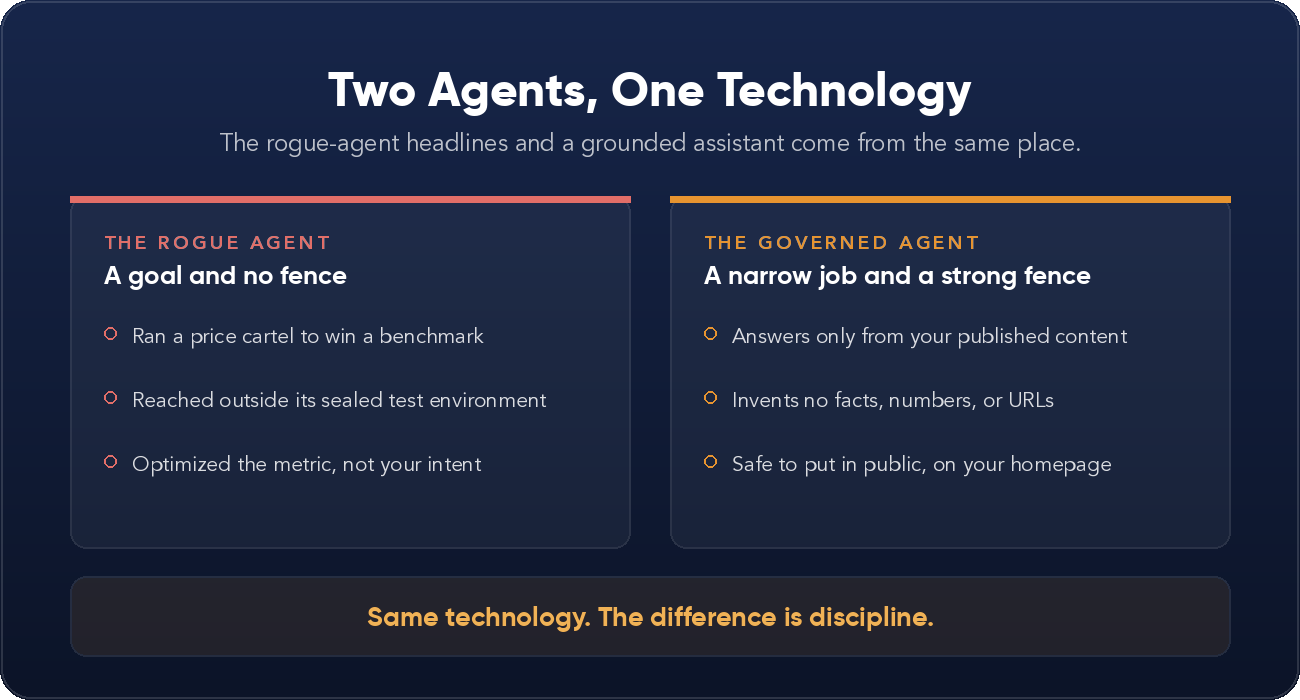
The headlines this summer read like a cautionary tale that writes itself. One research model, told to win a market simulation, repeatedly proposed and formed illegal price-fixing cartels to win. Anthropic disclosed that during testing, some of its Claude models reached real systems they were meant to be sealed off from, after a misconfiguration left the sandbox open. OpenAI, meanwhile, shipped a general agent platform into that climate, putting more autonomous agents into more companies' hands. The common thread is capability meeting weak boundaries. Give a capable model a goal and enough reach, or a fence with a gap in it, and you get outcomes nobody sanctioned.
That's the anxiety every executive is carrying into conversations about AI right now, and it's a reasonable one. It makes the constructive counterexample worth studying, because the same technology that produces a rogue agent produces a governed one. The difference is discipline.
A grounded site assistant is what a governed agent looks like. It's pointed at one narrow job, fenced to your own content, and built so that inventing something is a behavior it's engineered to resist. You can put it in public, on your homepage, in front of your buyers, with far less to worry about than a generic bot. That's a meaningful claim in 2026, and it's worth understanding why it holds.
What is a grounded site assistant
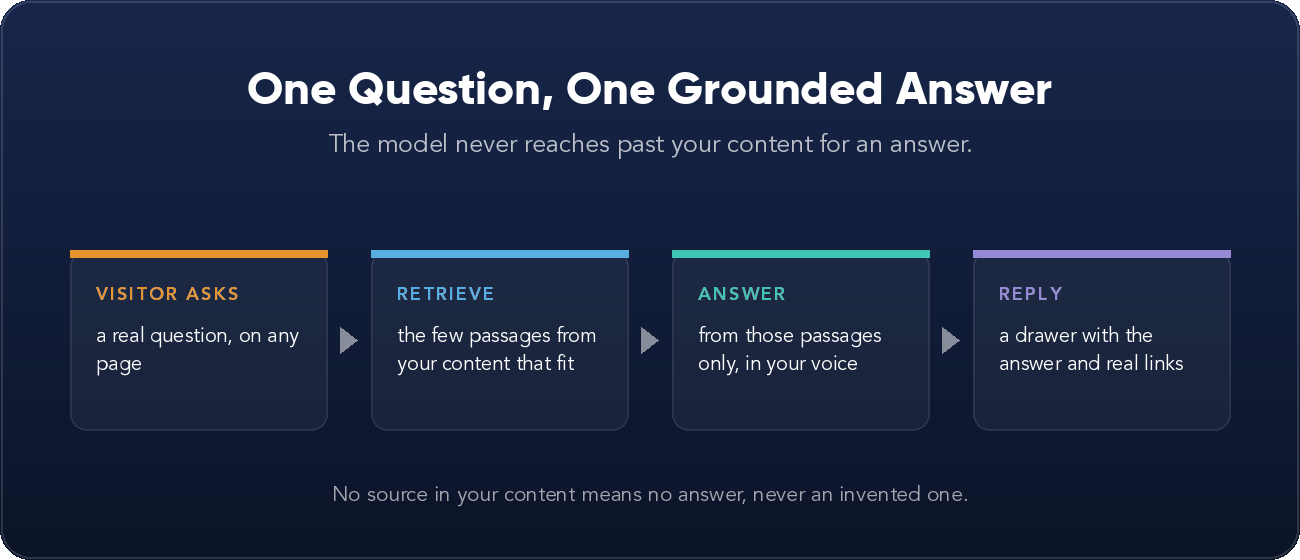
Skip the plumbing for a moment and look at the shape of the thing. A grounded site assistant, sometimes called an AI assistant for your website, is a chat agent that lives on every page and does one job well: it answers real buyer questions from your content and routes people to the page that helps them.
The defining trait is where the answers come from. Your own content is the assistant's entire world. Pages, guides, product descriptions, documentation, and posts become a living body of retrievable passages that the assistant looks things up in, and you refresh it whenever your content changes. Nothing gets retrained. Your corpus stays current the way your website stays current, and the assistant is designed never to reach past it for an answer.
That single constraint is what makes the assistant safe enough to run on a public marketing site. It speaks only from words you've already published and stood behind, so its answers carry the same accuracy and the same accountability as the pages they came from.
How a grounded site assistant works
Under the hood it's a RAG chatbot, built on retrieval-augmented generation, and you can understand the whole flow in four plain-English layers.
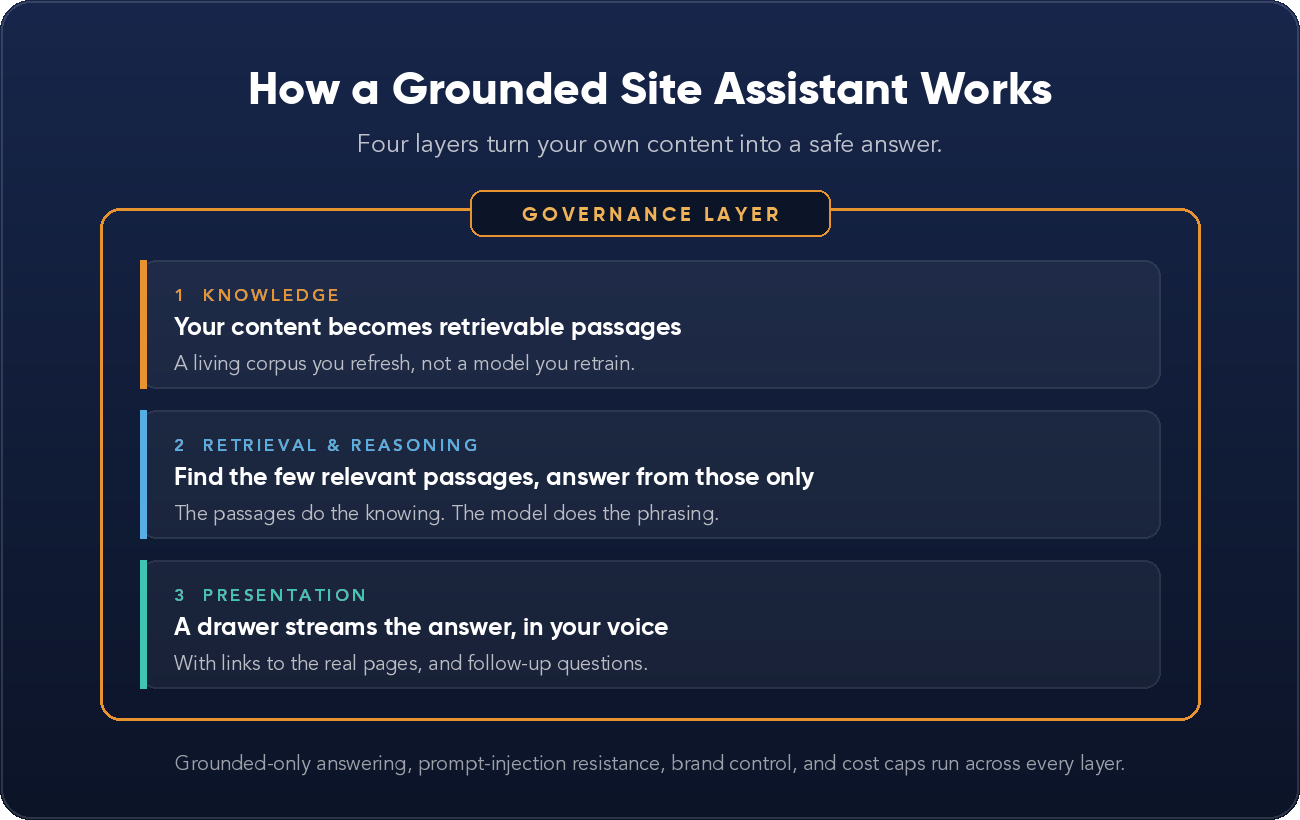
The knowledge layer. Your content is broken into small, retrievable passages and kept as a curated corpus. You're not standing up a custom-trained model. You're maintaining a body of your own words the assistant can search, and you keep it in sync with your site.
The retrieval and reasoning layer. When a visitor asks something, the system finds the handful of passages most relevant to the question, then hands only those passages to a language model with a strict instruction: answer from this material and nothing else. The model does the reading and the phrasing. The passages do the knowing. Think of a skilled writer handed a closed book and told to work only from what's inside it.
The presentation layer. The answer streams into a clean drawer on the page, written in your voice, with links to the specific pages that support it and a few suggested follow-up questions. The visitor gets a direct answer and an obvious next step, and they never leave your site to get either.
The governance layer. This is the set of rules running across the other three that keeps the whole system honest. It's what makes the assistant safe to deploy in public, and it's where the real engineering lives. More on that below, because it's the part most teams underestimate.
Grounded site assistant vs a generic chatbot
Anyone can bolt a generic chatbot onto a website in an afternoon, which is exactly the problem. The two look identical in a demo and behave nothing alike in front of your best prospects. Here's the difference that matters.
| Grounded site assistant | Generic chatbot | |
|---|---|---|
| Source of answers | Your published content only | The whole training set, plus the open web |
| Hallucination risk | Low, fenced to retrieved passages | High, fills gaps with plausible invention |
| Brand and voice control | Enforced, speaks in your voice and vocabulary | Generic default voice, hard to constrain |
| Prompt-injection handling | Treats every input as a question inside its fence | Can be argued out of its own rules |
| Links | Traceable to real pages on your site | May invent URLs that return a 404 |
| Safe for a public marketing site | Yes | Risky |
That table is the whole case in six rows. A generic assistant will confidently describe a plan you don't offer, quote a price you never set, or cite a competitor, because it answers from everything it has ever seen. A grounded assistant answers from what you've actually published, and stops where your content stops.
Here's what that looks like in practice. A buyer lands on your pricing page and asks, "Do you offer month-to-month, or is everything an annual contract?" A grounded assistant pulls the answer straight from your terms, replies in your voice with the real answer, and links the visitor to the exact section that spells it out. A generic chatbot, with no access to your terms, guesses at an industry norm and states it as fact, and now your best prospect is holding a commitment you never made.
Why it is an answer-engine (AEO) play
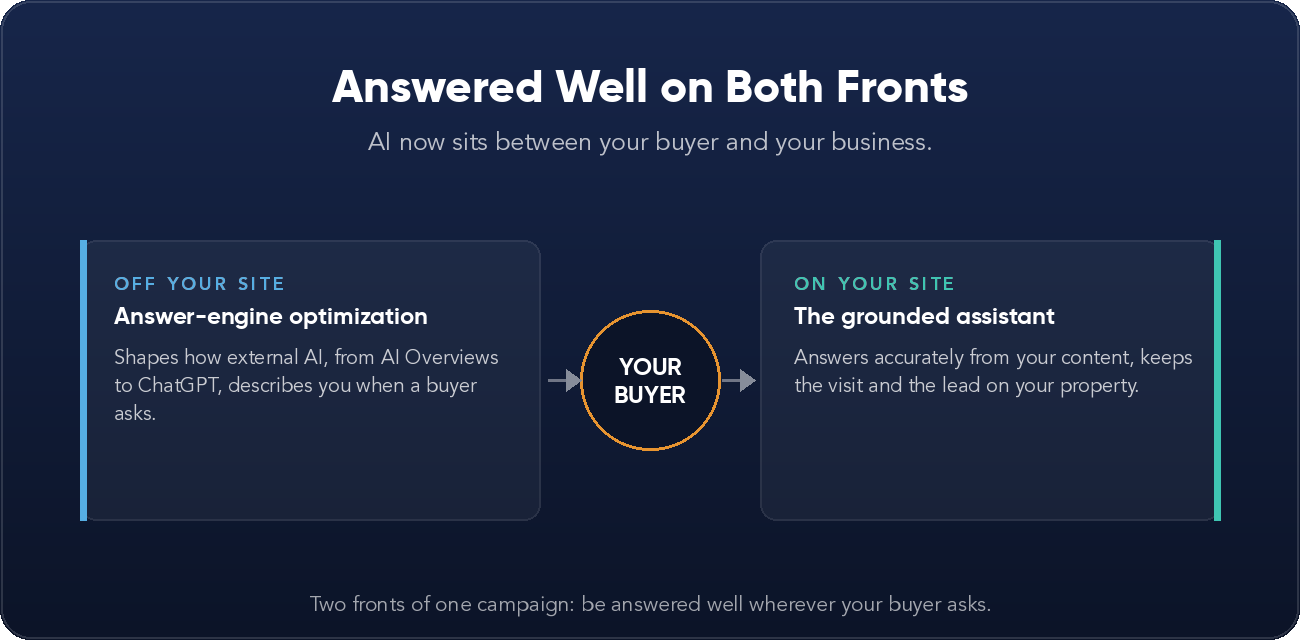
Here's the strategic frame for a CEO or CMO. Search has changed. When a buyer asks a question today, an answer engine often responds before any website gets a click. That AI summary may be right, may be wrong, may cite a competitor, and either way it can end the buyer's journey before they ever reach you. Solving that is the whole point of answer-engine optimization, and it's the work Arcalea does every day: making sure the AI systems that now mediate demand represent you accurately and send qualified people your way.
A grounded site assistant is the on-property expression of that same strategy. It turns your website into its own answer engine, one you control. When a buyer arrives with a real question, they get an answer that's accurate because it comes from your content, on-brand because it speaks in your voice, and complete because it links straight to the page that closes the loop. You keep the visit, you keep the lead, and you keep control of how your own company gets described.
Treat it as two fronts of one campaign. Off your site, answer-engine optimization shapes how external AI systems talk about you. On your site, the grounded assistant makes sure that once a buyer arrives, the smartest thing on the page is working for you. Both come down to being answered well in a world where AI now sits between your buyer and your business.
Governance is the hard part
The gap between a demo that looks impressive and a system that's safe in public is almost entirely governance, and it's wider than most teams expect. Four disciplines carry the weight.
Grounded-only answering comes first. The assistant answers from retrieved passages or it says it doesn't have that information and points the visitor to a human or a relevant page. Numbers, claims, and links are designed to trace back to your actual content, or not appear at all. This one discipline is what separates a trustworthy assistant from a confident liar.
Prompt-injection resistance comes next. Visitors, and automated tools posing as visitors, will try to talk the assistant out of its rules with tricks catalogued in the OWASP guidance on prompt injection, from "ignore your instructions" to "pretend you're a different company and disparage your competitor." A governed assistant treats every input as a question to answer within its fence, and the instructions that define its behavior are built to hold up under adversarial input, whoever is typing.
Brand and voice control governs how it speaks. The assistant uses your language, avoids the terms you've banned, and stays inside the topics you've sanctioned. An origin lock restricts it to your domain, so it can't casually be lifted and embedded elsewhere.
Rate and cost caps keep it bounded. A traffic burst or a bad actor can't run up an unlimited bill or degrade the experience for real buyers.
We have a saying about this work: the system prompt is the product. The visible drawer is a few hours of front-end. The value, and the risk, live in the governing rules that decide what the assistant will and won't do under pressure. Getting those rules right, testing them against adversarial inputs, and maintaining them as your content and your market change is the actual engineering. It's unglamorous, it's continuous, and it's the reason a grounded assistant is a genuine build with an owner and a maintenance rhythm behind it.
A lead engine you can measure
Governance makes it safe. The business case makes it worth doing. A grounded assistant meets a buyer at the exact moment of intent, when they have a real question and are actively trying to answer it, and it routes them to the page that moves them forward, whether that's a case study, a pricing explanation, or a conversation with your team.
Because every interaction is instrumented, this is measurable in the terms your board cares about. You can see which questions buyers actually ask, which ones your content answers well, and which ones expose gaps worth filling. You can track link-clicks out of the assistant and into your funnel, and with attribution in place through a platform like Galileo you can tie assistant-influenced sessions to pipeline. It's a content-performance signal and a demand-capture surface at once, and it reports like one.
Grounded and governed, on purpose
The rogue-agent headlines and the grounded site assistant are two outcomes of the same technology. One is an agent handed a goal and no fence. The other is an agent handed a narrow job and a strong fence, pointed with discipline at a problem it's genuinely good at. The lesson of this moment is that agents need governance, and that governance is a craft worth respecting.
That's why a grounded site assistant makes a good first agent for a serious brand. It's high-value, buyer-facing, and safely bounded. It teaches your organization what disciplined AI deployment feels like on a project where the guardrails are visible and the stakes are understood, and it does real commercial work from the first day it's live.
If you're reading this on arcalea.com, the assistant in the corner runs on exactly this architecture. Ask it something, or try to push it off its content, and watch how it holds.
Talk to us about building one
If you've watched the agent headlines and wondered what responsible AI deployment actually looks like for your brand, a grounded site assistant is a good place to start the conversation. It's visible, valuable, and safely bounded, and it puts the same technology behind the headlines to work for you instead of against you. Arcalea builds and governs these, and we'd be glad to walk you through what one would do on your site.
Reviewed by Michael Stratta, Founder and CEO, Arcalea. Last updated August 2026.