Galileo | Attribution Intelligence
Every platform claims it drove the conversion. Galileo measures who earned it.
GA4, HubSpot, and Salesforce all see the same journey differently.
Each platform reports attribution from within its own walls. Google credits Google. HubSpot credits HubSpot. The result is not a measurement: it is a negotiation between conflicting self-reports.
First-party data. No walled gardens. No borrowed truth.
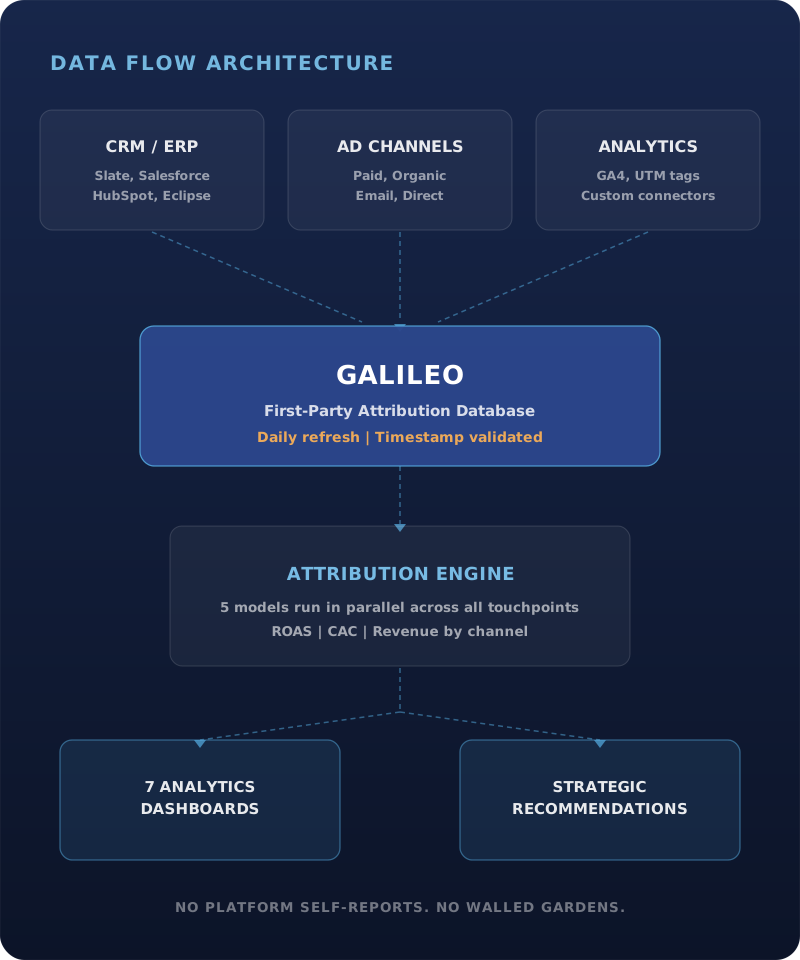
Galileo connects directly to the system of record for your conversions: your CRM or ERP. It maintains its own first-party database of every touchpoint and conversion, independent of what any ad platform, analytics tool, or CRM vendor reports about itself.
The result: attribution that is not biased by who is reporting it. Galileo is immune to the walled-garden effect because it never asks any platform what it saw; it measures what actually happened.
First-party conversion data
Galileo reads directly from your CRM or ERP and maintains its own database, so the record of what converted, when, and for how much is always yours and always clean.
Any time horizon
B2B sales cycles, long enrollment funnels, complex procurement journeys: Galileo measures the full path regardless of how many months it spans.
Cross-channel fractionalization
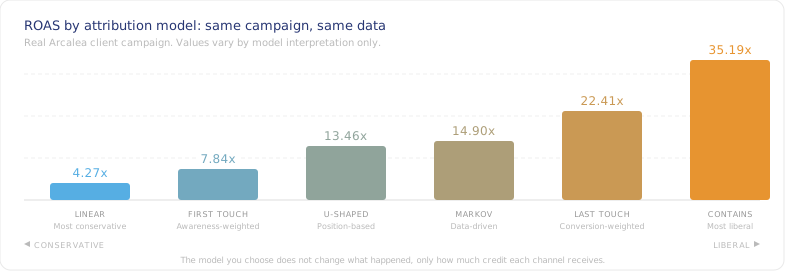
Every dollar of revenue is distributed across the channels that contributed to it. Five models let you see the full range of defensible interpretations.
One journey.
Five defensible
interpretations.
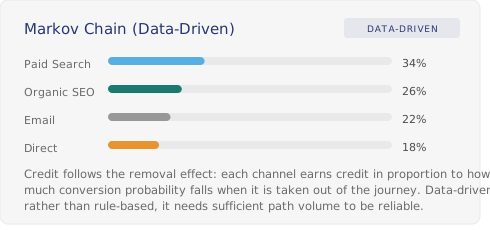
The debate over attribution credit is not a technical problem; it is an interpretive one. No single model is universally correct. Each makes a different claim about which touchpoints mattered and how much.
Galileo runs all five models in parallel against your actual conversion data, so your team can see the full range of defensible answers rather than anchoring to one platform's default assumption.
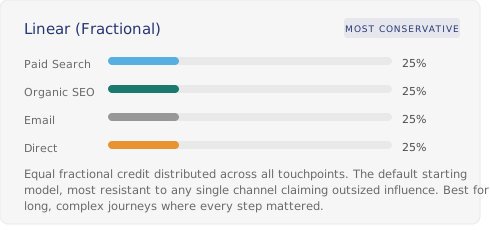
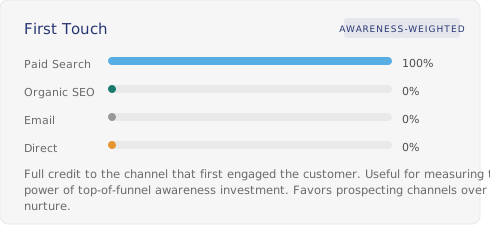
The same conversion. Wildly different credit.
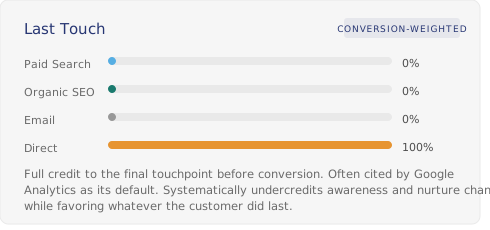
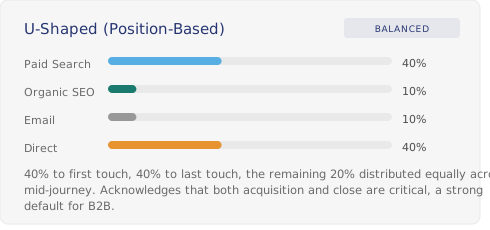
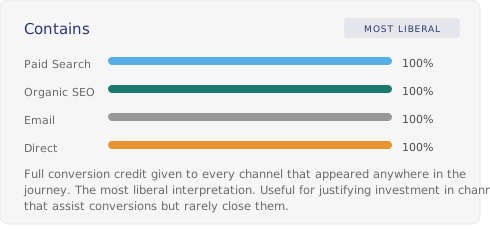
A customer sees a paid search ad, reads an organic blog post three weeks later, receives a nurture email, then converts directly. Who drove the sale?
Ask Google Analytics (last touch): direct gets 100% of the credit. Ask a first-touch model: paid search takes everything. The truth lies somewhere in the full range, and Galileo shows you all of it.
With five models running simultaneously against your actual CRM data, you can defend any channel investment and identify which channels are systematically undercredited or overcredited in your current reporting.
Attribution tells you
what happened.
Galileo tells you what to do next.
The debate over attribution credit is not a technical problem; it is an interpretive one. No single model is universally correct. Each makes a different claim about which touchpoints mattered and how much.
Galileo runs all five models in parallel against your actual conversion data, so your team can see the full range of defensible answers rather than anchoring to one platform's default assumption.
Response curve modeling
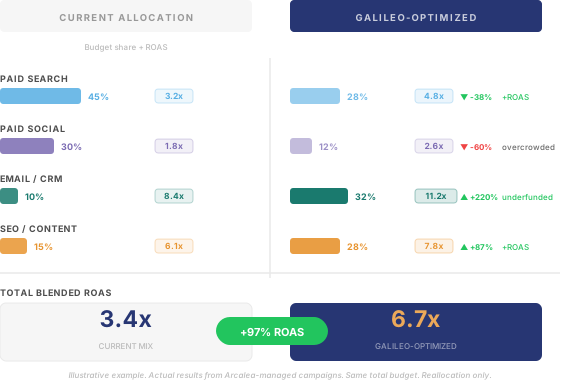
Galileo uses your historical attribution data to model the marginal return curve for each channel: the return on every additional dollar spent. Most channels show clear diminishing returns beyond a threshold.
Identify over- and underfunded channels
Channels where marginal ROAS is still high but budget share is low are underfunded. Channels past their efficient frontier are overcrowded. Galileo surfaces both, along with the dollar magnitude of the gap.
Calculate the optimal allocation
The model solves for the budget split that equalizes marginal ROAS across all channels: the mathematical efficient frontier. The output is a concrete, defensible reallocation recommendation.
Model the projected impact
Before any dollar moves, Galileo projects the ROAS improvement from the recommended allocation. Your team can pressure-test the model, adjust constraints, and see the projected outcome of each scenario.
"Most organizations are not spending the wrong total. They are spending the right total in the wrong places. Galileo finds the places."
Six dashboards. One version of the truth.
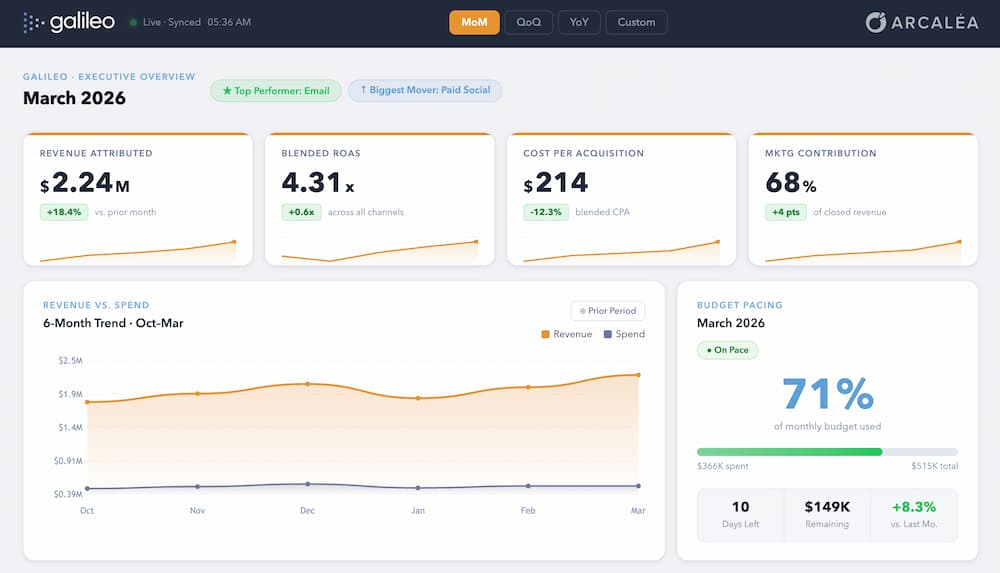
Every Galileo dashboard refreshes daily with timestamp validation. From high-level executive summaries to granular channel breakdowns, each view is built for a specific decision, not for a specific audience's preferred narrative.
Pipeline Performance
Full visibility into conversion pipeline health by channel and campaign. Tracks every stage from first inquiry through close, with funnel drop-off identification and source attribution.
Pipeline Velocity
Measures conversion speed at every stage. Time-to-status tracking by channel surfaces bottlenecks before they become missed targets. Cycle-over-cycle pacing comparison built in.
Multi-Touch Attribution
The core attribution view. Channel contribution cards for Paid Search, Organic, Email, Direct, Referral, and Social. Campaign-level ROI. Touchpoint analysis by funnel stage. Run across all five models simultaneously.
Economic Analysis
Links marketing investment to revenue outcome. ROAS, CAC, and channel efficiency by spend tier. Program- and segment-level profitability. The answer to the CFO's question: what did this actually return
Paid Media Executive Summary
Concise month-over-month and year-over-year overview for leadership. Spend, impressions, leads, conversions, and cost efficiency in a single view. Built for the CMO who needs the story in 60 seconds.
Paid Media Deep Dive
Granular operational analysis across every platform: Google, Meta, LinkedIn, programmatic, and beyond. Platform-by-platform cost efficiency, ad type performance, and campaign-level tables for tactical optimization.
Galileo answers the question
each stakeholder is actually asking.
Platform access that fits how your team works.
Galileo is available as a self-serve platform with full dashboard access, or as an Arcalea-managed service where our analysts interpret results and translate them into channel strategy. Both models use the same first-party database and the same five attribution models.
Galileo + Arcalea Intelligence
Arcalea's team connects the integrations, maintains the database, interprets the attribution outputs, and delivers channel-level recommendations. You get the dashboards plus the strategic layer that turns data into action.
- Full platform setup and integration management
- Monthly attribution analysis and reallocation recommendations
- All 6 dashboards with annotated performance review
- Quarterly executive reporting in CFO-ready format
- Direct access to your Arcalea attribution analyst
Galileo Platform Access
Direct platform access for organizations with internal analytics teams. Your team connects the integrations, configures attribution models, and manages the dashboards independently. Arcalea provides onboarding and support.
- Full access to all 6 dashboards
- All 5 attribution models configurable by your team
- Direct CRM / ERP integration setup with Arcalea support
- Daily automated data refresh with timestamp validation
- Used by independent agencies and in-house teams
Attribution that changed
the investment decision.
Kellogg School of Management used Galileo to measure the full-funnel contribution of every marketing channel across their Executive MBA program. The platform connected to the admissions CRM, tracked the complete applicant journey, and ran all five attribution models against actual enrollment outcomes.
The results overturned assumptions the team had held for years about which channels were driving conversions, and justified a significant reallocation of paid media spend.
Attribution is not a technical problem. It is an interpretive one. Galileo shows you the full range of defensible answers.
Related Reading
Dig deeper into attribution methodology, then see how the other platforms in the Measure lane complete the picture.
Multi-Touch Attribution: How to Measure the Full Customer Journey
Why single-touch models misattribute revenue and how multi-touch models reveal the full picture.
Read article →A Complete Guide to Attribution Models
Linear, first-touch, last-touch, U-shaped, and data-driven — when each model applies and what it obscures.
Read article →GA4 Data-Driven Attribution: What It Measures Well and Where It Falls Short
What GA4 actually does under the hood and why it cannot replace CRM-level attribution.
Read article →AEO Index
AI search visibility. Track whether ChatGPT, Perplexity, and Google AI cite your brand.
Explore →QMA
Quantitative market assessment. Validate opportunity size before committing budget.
Explore →Compass
Search intelligence that converts organic rankings into dollar-denominated financial terms.
Explore →Paid Media
Galileo attribution powers our paid media service.
Explore →Data & AI Systems
Attribution delivered as a managed service.
Explore →See how Galileo fits into the complete
intelligence model.
Galileo attributes revenue back to every channel. QMA establishes the market intelligence that guides investment. Compass maps the organic opportunity. The AEO Index tracks AI visibility. All four run together or independently. Explore Arcalea's intelligence platform.
HubSpot, Salesforce, SugarCRM, Slate, Epicor, Tealium, and custom API. Attribution data lands in your system of record -- no exports required.
See what your data actually shows.
Request a Galileo demo and bring your own attribution question. We will run your data through all five models and show you where the credit actually belongs.
Questions about Galileo
Galileo is Arcalea's multi-touch attribution platform. It connects directly to your CRM or ERP, maintains its own first-party database of conversion records, and measures the actual contribution of every marketing channel, campaign, and touchpoint across the full customer journey.
GA4 uses a 90-day attribution window, samples data, aggregates by session rather than individual, and can only track proxy actions rather than actual revenue conversions. It cannot attribute to the specific keyword searched or creative seen. Galileo measures from the actual CRM or ERP conversion record with no time horizon limit, no sampling, and full campaign and creative granularity. Unlike GA4, HubSpot, and Salesforce, Galileo does not rely on any walled garden's self-reported numbers.
Galileo supports five attribution models: Linear (equal credit across touchpoints), First Touch (100% to first channel), Last Touch (100% to final channel), U-Shaped (40/40/20 split), and Contains (100% to all channels). Together they bracket the full interpretive range from conservative to liberal.
Galileo has direct integrations with Slate, Epicor Eclipse, Salesforce, and HubSpot. Data from these systems feeds Galileo's own first-party database, ensuring independence from any platform's self-reported numbers.
Both options are available. Galileo is offered as a self-serve SaaS platform with full dashboard access, or as an Arcalea-managed service where our analysts interpret results and translate them into channel strategy.
Clients using Galileo have reallocated budget to measured channels, reducing wasted ad spend by 35 percent and achieving ROAS improvements up to 325 percent. Results depend on current state of measurement and budget optimization.