Teaching Attribution as a Decision Problem: A Graduate-Level Examination
A 3-part teaching case published through Harvard Business Publishing in 2025 examines multi-touch attribution not as a reporting exercise but as a structured decision problem under uncertainty. Galileo serves as the analytical instrument through which that decision unfolds.
Business
Publishing
Harvard Business Publishing selected Arcalea's Galileo platform as the analytical foundation for a published case study series, now used at business schools to teach modern, data-driven marketing attribution.
Learn more about the Arcalea team.
Attribution is not a reporting problem. It is a decision problem.
Marketing budget allocation is, at its core, an optimization problem. Given a fixed budget, a set of channels, and historical performance data by channel, what combination of investments produces the most revenue? That question sounds tractable until you ask a follow-up: how do you know what each channel is actually producing? Traffic is not revenue. Leads are not patients. A channel that generates significant volume at the top of the funnel may produce almost nothing at the bottom. The data required to answer the optimization question correctly is not the same data most marketing teams have access to.
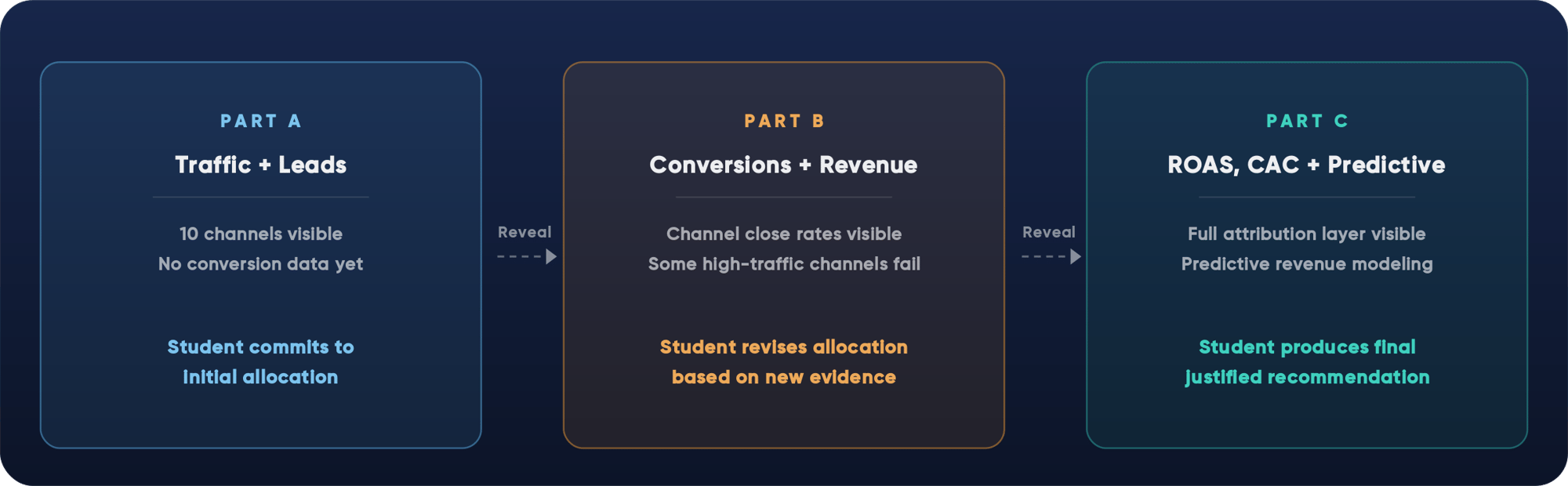
This is the problem the Kellogg case is built to examine. Students take the role of Elysian's marketing director and are asked to determine the profit-maximizing budget allocation across ten digital channels. They are not given all the relevant data at once. They are given it in stages (traffic and leads first, then conversions and revenue, then ROAS, CAC, and predictive modeling) and required to commit to an allocation at each stage. The case demonstrates, through the student's own successive revisions, how much the optimal answer changes as each layer of data becomes available.
The central difficulty is not analytical. It is informational. Most marketers allocate budgets with access to the first layer of data but not the last. The case makes the cost of that gap visible by requiring students to live through it in sequence.
Why existing curricula fall short
Budget allocation exercises in graduate marketing programs typically present students with complete data and ask them to choose well. The Elysian case inverts that: students are given incomplete data and asked to commit to an allocation anyway, then shown what they got wrong when more data arrives. That sequence is how the problem actually works in practice.
The optimization constraint
The correct allocation in Phase C (a six-channel mix out of the original ten) is not discoverable from Phase A data. Four channels are eliminated entirely once ROAS and CAC are introduced. Students who allocated to those channels in Phase A did so rationally, with the information they had. The case shows why that rationality was insufficient.
Why the case uses a live platform
Attribution data has to be generated, not assumed. Galileo provides the full layered stack (traffic through predictive revenue) in the sequence the case requires. Students work with the same data architecture a marketing director would actually use to solve this problem, not a simplified textbook version of it.
Three-Part Progressive Disclosure
Prof. Sawhney structured the case across three sequentially released parts. Each part opens with the same question: given the available data, how should this $1.44M budget be reallocated? Each part then reveals information that invalidates or complicates the previous answer. The design forces students to experience the cost of incomplete data while developing a principled process for decision-making under successive uncertainty.
First Commitment Under Limited Information
Students receive channel-level traffic and lead data for all 10 digital channels in Elysian's media mix. Conversion and revenue data are not yet available. The question is straightforward: given only volume and reach data, how would you initially allocate this budget? Students must commit to a position in writing before Part B is released.
Revision When the Revenue Picture Changes
Conversion and downstream revenue data are introduced. Several channels that appeared strong in the Part A dataset turn out to have poor close rates. Channels that seemed to underperform on traffic were, in fact, contributing to the conversion path. Students must reconcile their Part A commitment with this new evidence and produce a revised allocation with an explicit account of what they got wrong and why.
Final Recommendation with Full Attribution Architecture
The complete Galileo dataset is made available: ROAS by channel, customer acquisition cost, and predictive revenue projections. Four of the original ten channels no longer justify their budget allocation. Students produce a final recommendation for a six-channel mix, with a written brief explaining which channels they cut, which they increased, and why the data supports each decision.
Why Galileo's Multi-Model Architecture Made This Case Possible
The optimization problem at the center of the case requires data that most attribution tools do not surface together. Traffic by channel is easy to get. Revenue by channel is harder. ROAS and CAC require attribution that connects the marketing investment to actual patient acquisition, not just a click or a session. Predictive revenue modeling requires confidence in the attribution layer below it. Each of these depends on the one before it.
Galileo is structured as a sequential data stack. It begins with traffic and leads, adds conversions and revenue, then layers in ROAS, CAC, and predictive output. That architecture is what made the case possible: the platform could be disclosed to students one layer at a time, with each layer changing the optimization answer in a way students had to explain and defend. The platform does not produce the optimal allocation for the student. It produces the data the student needs to derive it.
The case is designed to show what changes when each layer of data is added, and why most attribution decisions made from incomplete data are wrong. Students who hold their Phase A allocation into Phase C will have been significantly off. That is not a failure of reasoning. It is a demonstration of why complete attribution data is the prerequisite for sound budget optimization.
A $1.44M Budget Across Ten Digital Channels
The case is grounded in a real media mix for a Northern California fertility clinic generating approximately $10 million in annual revenue. The breadth of the channel set is part of the instructional design: students encounter a mix that includes both high-performing and underperforming channels, and several whose apparent contribution looks very different at the traffic layer than it does at the revenue layer. The optimization problem only becomes solvable once all layers are visible.
Co-Authored for Graduate Instruction
The case was developed as a collaborative academic project between a senior marketing faculty member at the Kellogg School of Management and a practitioner working directly with the attribution platform at the center of the case. That combination produced something graduate business education rarely has access to: a dataset that is both analytically complete and grounded in actual marketing operations, structured by an educator who has spent decades building decision-focused pedagogy for MBA students.
Prof. Mohanbir Sawhney
One of the most cited scholars in marketing and technology management, Prof. Sawhney has authored numerous teaching cases distributed through Harvard Business Publishing across areas including digital marketing, platform strategy, and data-driven decision-making. His case work is used in MBA programs worldwide. The Elysian case was developed within his graduate digital marketing curriculum at Kellogg.
Michael Stratta
Stratta holds an MBA from the Kellogg School of Management and founded Arcalea, the firm behind Galileo. That background informs the case in a specific way: he built the platform with an understanding of how marketing decisions are taught and examined at the graduate level, not only how they are made in practice. His contribution to the case was the underlying dataset, the platform architecture, and the practitioner context that allowed Prof. Sawhney's pedagogical design to operate at the analytical depth graduate instruction requires.
The Learning Outcomes Embedded in the Case Design
A well-designed teaching case does not teach facts. It teaches reasoning under conditions that mirror the conditions practitioners actually face. The Elysian case was built around specific learning outcomes that the progressive disclosure structure forces students to develop: the ability to make sound decisions with incomplete data, accountability for those decisions when more complete data arrives, and the discipline to translate an attribution-informed analysis into a clear, justified budget recommendation.
Optimization Under Data Constraints
The case teaches students that the profit-maximizing budget allocation is a function of the data available, not a fixed answer. What looks like the right allocation at the traffic layer is often meaningfully wrong at the revenue layer. The optimization problem is only solvable once attribution data is complete, and completeness takes time and the right analytical infrastructure to achieve.
Accountability for Prior Decisions
Because students commit to an allocation in writing before each subsequent data release, they cannot retroactively claim their initial reasoning was more sophisticated than it was. Part B and Part C require students to engage honestly with what they got wrong in previous parts, producing the kind of reflective analytical practice that graduate education is designed to develop.
Decision Communication Under Ambiguity
The final deliverable is not a spreadsheet. It is a written recommendation brief addressed to a marketing director who must present to a board. Students must translate analytical conclusions into a clear, justified position that a non-technical audience can evaluate. This is among the most consistently underdeveloped skills in graduate marketing education.
The Cost of Incomplete Data
Part A is designed so that a reasonable first-pass analysis will produce an allocation that Part B then partially invalidates. Students experience, rather than simply read about, the risk of committing resources based on incomplete information. This experience is more instructionally durable than any case study that presents all information upfront.
Channel Path vs. Channel Credit
One of the more durable insights from the case is the distinction between what a channel produces in volume and what it produces in revenue. Several channels in the Elysian mix drive significant traffic and leads while contributing very little attributed revenue. Students who allocated to those channels based on Phase A data made a defensible decision with the information they had. Phase C shows them why that decision was wrong and what data they needed to avoid it.
Platform Architecture as an Analytical Choice
By working directly with Galileo across all three parts, students develop a practical understanding of what it means to select an analytics platform for attribution work. The case demonstrates that platform architecture is not a neutral infrastructure decision but a choice that shapes which questions a marketer is able to ask and how the answers are structured.
Read the Case Through Harvard Business Publishing
All three parts of the Elysian Fertility and Surrogacy case are available through the Harvard Business Publishing case library. The case is licensed for use in graduate marketing programs through standard HBP institutional access.