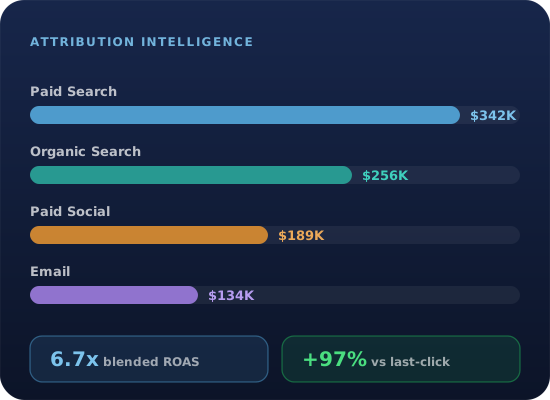
Galileo is Arcalea's proprietary marketing attribution and analytics platform. It ingests data from paid media, organic search, CRM, and offline channels to build a unified view of what is actually driving revenue. Unlike off-the-shelf tools, Galileo is built for multi-touch attribution in complex B2B and high-consideration sales cycles.
Three proprietary platforms. Built because nothing else existed.
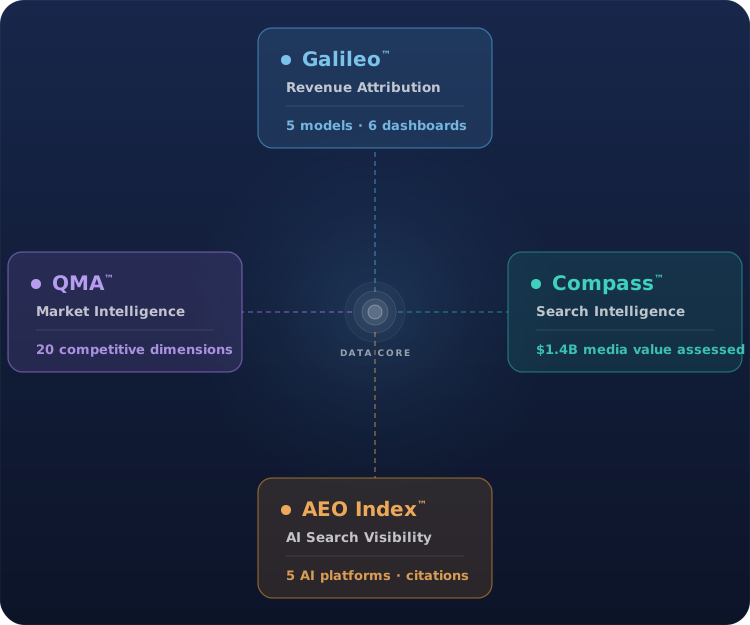
Galileo connects every marketing dollar to closed revenue. Compass turns search into a measurable financial asset. The AEO Index tracks exactly how and whether your brand appears when AI answers the questions your buyers are asking. 3 systems. One thesis: outcomes over proxy metrics.
Your attribution model is probably wrong. Galileo fixes that.
Most attribution platforms apply generic models (last-click, linear, time-decay) that ignore the actual conversion patterns in your data. Galileo is built differently: it ingests data from paid media, organic search, CRM, and offline channels, uses machine learning to assign fractional revenue credit across the full conversion path, and connects to CRM data to measure closed revenue rather than proxy conversions like form fills or sessions.
Built from the ground up over eight years and refined across production deployments in complex B2B, higher education, and enterprise accounts, Galileo's methodology has been qualified as expert-grade analysis in federal court and named a Fortune Most Innovative Product in 2024.
- Multi-touch attribution that reconciles with your CRM and revenue data
- Predictive channel weighting updated automatically as market conditions shift
- Unified view across paid, organic, email, and offline sources
- Executive-ready reporting pushed on your cadence, not when someone asks
Multi-Touch Attribution
Custom models that accurately assign credit across every channel, campaign, and touchpoint.
Predictive Modeling
Forward-looking channel forecasts grounded in your actual conversion patterns, not industry benchmarks.
Prescriptive Insights
Specific, ranked budget reallocation recommendations generated from your data, not generic advice.
Live Data Pipelines
Native connectors to Google Ads, Meta, GA4, Salesforce, HubSpot, and 40+ additional sources.
SEO is a financial asset. Compass proves it.
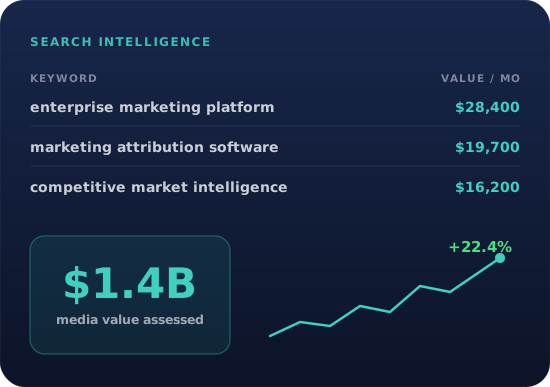
Compass was one of the first platforms to apply machine learning to decompose organic search ranking factors, built years before AI became a marketing buzzword. It tracks keyword opportunity, competitive SERP positioning, and content performance across the full organic surface, then converts every signal into revenue terms. Not traffic. Not rankings. The dollar value of organic.
- ML-based ranking factor decomposition: what's actually driving position changes
- Competitive SERP share tracking across priority keyword sets
- Content performance scoring tied to organic revenue, not traffic proxies
- SEO ROI modeling: what your organic investment is worth in closed revenue
ML Ranking Analysis
Decompose what actually moves rankings: not correlation guesses, but machine-learning attribution across the full ranking signal set.
SERP Share Tracking
Monitor competitive search presence across priority keywords. Know exactly where you win, lose, and where opportunity is going uncaptured.
SEO ROI Modeling
Translate organic performance into financial terms. Defend the SEO budget with the same rigor used for paid media spend.
Opportunity Forecasting
Project the revenue impact of capturing target keyword positions before committing resources to the campaign.
AI answer engines are recommending brands. Is yours one of them?
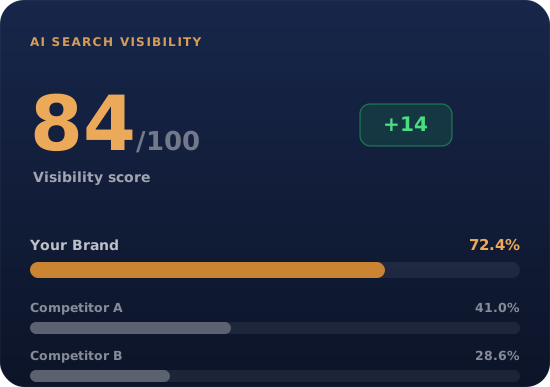
ChatGPT, Perplexity, Google AI Overviews, Gemini, and Copilot now answer the questions that used to drive traffic to your website. Most organizations don't know whether they appear in those answers, whether the answers are accurate, or who their AI-visible competitors are. The AEO Index makes all of that measurable, tracking brand citation frequency, accuracy, and competitive AI share of voice across every major AI search platform.
- Brand citation tracking across ChatGPT, Perplexity, Google AI Overviews, Gemini, and Copilot
- Accuracy monitoring: detect when AI systems misrepresent your brand
- Competitive AI share of voice: who owns the category in AI-generated answers
- Citation source analysis: what content is driving AI recommendations
Citation Tracking
Measure how often AI systems cite your brand across five platforms, segmented by query type, category, and competitor set.
Accuracy Monitoring
Detect when AI systems misrepresent your brand, products, or services, and identify the source content causing the error.
AI Share of Voice
Benchmark citation frequency against direct competitors. Know who owns the AI-generated answer in your category.
Source Attribution
Trace which pages, schema types, and content formats drive AI citations, then replicate that structure across your site.
We use AI. Here's exactly how.
Arcalea's production AI stack spans six functional layers: language models (Claude, GPT-4o, Gemini Pro), data and analysis infrastructure (BigQuery ML, Vertex AI, Python), workflow automation (n8n, Make, custom agents), research intelligence (Semrush AI, Perplexity Deep Research), creative production (Midjourney, Adobe Firefly, Runway), and human-in-the-loop governance. All AI-generated outputs are reviewed and validated by senior strategists before delivery. No AI-generated content reaches a client without human sign-off.
Intelligence Layer
Analysis Infrastructure
Process Layer
Intelligence Gathering
Production Layer
Human-in-the-Loop
Accuracy First
Every AI output is fact-checked against primary sources before delivery. Speed never supersedes accuracy.
Full Auditability
We document which tools touched which outputs. Clients can always ask what was AI-assisted and what wasn't.
Data Privacy
Client data is never used to train external models. We operate under strict data handling agreements with every AI vendor.
Human Judgment
AI accelerates; humans decide. Strategy, creative direction, and final recommendations always require human sign-off.
Questions about the platforms, answered
Compass is Arcalea's operational intelligence and reporting platform. Where Galileo focuses on marketing attribution and demand-side measurement, Compass tracks economic contribution, revenue forecasting, and organizational performance for COOs, CFOs, and board-level stakeholders. Galileo answers "what is working in marketing"; Compass answers "what is this worth to the business".
Arcalea uses AI for predictive audience modeling, automated bid optimization, content performance scoring, AEO and GEO optimization, and agentic workflow automation. The AI stack runs on top of Galileo data, so recommendations are grounded in client-specific performance signals rather than generic benchmarks.
Galileo connects natively to Google Ads, Meta Ads, HubSpot, Salesforce, GA4, and most major paid and CRM platforms via API. For custom or legacy systems, Arcalea builds data pipeline connectors. Integration is handled by Arcalea's engineering team and typically completes within 30 days of engagement start.
Most attribution tools apply generic models (last-click, linear, time-decay) that ignore actual conversion patterns in your data. Galileo builds a client-specific attribution model calibrated to your sales cycle length, channel mix, and deal velocity. The result is attribution that reflects your business, not a vendor's default assumption.
Yes. All client data ingested into Galileo and Compass is owned by the client. Arcalea does not sell, license, or use client data for any purpose other than delivering services to that client. Data portability is included in all engagement agreements.
The diagnostic should precede the investment.
Galileo, Compass, and the AEO Index measure and optimize, but they measure best when pointed at the right targets. The QMA is how we establish those targets before any platform is configured or any budget is committed. It's not a dashboard. It's a structured analytical engagement that maps the competitive landscape across 20 dimensions so the platforms deploy with precision, not assumptions.
Establish the quantitative baseline: share of voice, competitive set identification, digital footprint, and unaided brand awareness across the target market.
Apply statistical and ML techniques to model ranking factors from 2,000+ analyzed pages, separate structural demand from event-driven effects, and identify gaps your competitors haven't closed.
Translate findings into a sequenced action roadmap tied to the data. This is where the three platforms pick up: Galileo tracks attribution against QMA-identified channels, Compass prioritizes QMA-flagged keyword gaps, and the AEO Index benchmarks QMA-targeted competitive positions.
Related Reading
Go deeper on search intelligence and organic strategy, then explore the other platforms that share the Measure lane with Compass.
The Architecture of Authority in 2026: How SEO, AEO, and GEO Win
The three-layer content framework that earns citations from both traditional and AI search engines.
Read article →Share of Voice in 2026: Search, AI, and Paid
How to measure competitive presence across every channel that carries intent.
Read article →Keywords, Alt Text, and Meta Descriptions in 2026
Entity optimization beyond traditional keyword targeting — what search engines actually index now.
Read article →Galileo
Multi-touch attribution that closes the loop between every channel and closed revenue.
Explore →AEO Index
AI visibility tracking. Know whether ChatGPT, Perplexity, and Google AI cite your brand.
Explore →QMA
Quantitative market assessment. Validate opportunity size before committing budget.
Explore →Arcalea captures primary data before any third-party platform interprets it, then pushes attribution directly to your CRM -- HubSpot, Salesforce, Slate, and more.
Ready to see the platforms working on your data?
A Galileo + Compass demo takes 45 minutes. Most clients walk out with an immediate action item.