

Table of Contents
- Executive Summary: The Transaction Layer
- The Mechanism: Universal Commerce Protocol
- Part 1: Paid Media (The Vetting Engine)
- Part 2: Organic Data (The Source of Truth)
- Implementation: Sector Playbooks
- Summary
- Appendix: Sources
Executive Summary: The Transaction Layer
The internet is undergoing a fundamental shift from retrieval (Search) to reasoning (Agents). To win in this era, brands must build an Architecture of Authority.
The recent launch of the Universal Commerce Protocol (UCP) by Google and Walmart exemplifies how Agent readiness works in practice. It shifts the internet’s operating system from Search to Action.
While the headlines focus on retail shopping, this technology fundamentally redefines how all decisions are made online.
- For Retail: The transaction is a purchase (buying shoes).
- For Services: The transaction is a verified recommendation (shortlisting a partner, generating a bill of materials, or booking a consultation).
In this new environment, brands must be both recommended by the algorithm (Paid) and verified by the architecture (Organic). This post details how to optimize for this behavior across both battlegrounds.

The Mechanism: Universal Commerce Protocol
What is the Universal Commerce Protocol (UCP)?
The Universal Commerce Protocol (UCP) is the standardized "Action Schema" framework that enables AI agents to access real-time data. It allows AI to browse catalogs, verify service availability, and execute transactions directly, bypassing the traditional "visit-to-convert" website funnel.
1. How it Applies to Organic Strategy (AEO)
In the context of the Transaction Layer, Agent Engine Optimization (AEO) is the modern evolution of Organic Search. Unlike traditional SEO, which focuses on rankings, AEO focuses on data fidelity. It ensures your organic Source of Truth (inventory, pricing, credentials) is structured so the Universal Commerce Protocol can read, verify, and serve it.
2. How it Applies to Paid Media (Ad Validation)
For paid campaigns, the UCP functions as a real-time truth filter. Before an agent serves a sponsored product or service, it queries the protocol to verify availability and pricing. If the data isn't accessible or conflicts with your ad copy, the impression is blocked. You cannot buy your way out of unstructured data.
The Takeaway: The UCP acts as the single source of truth for both channels. Readiness is no longer channel-specific; it is architectural.
Part 1: Paid Media (The Vetting Engine)
How AI Agents are evolving from research tools into primary shopping interfaces.
From Search Results to Conversational Checkout
AI Agents are becoming transactional by design. Through real-time integrations, conversational intent can now convert directly into a purchase or a verified lead without a website visit.
- The Retail Example (Walmart–Gemini): Enabled by the UCP, a user can now ask Gemini for camping gear, and the agent will retrieve live inventory and complete the checkout, all without the user ever touching Walmart.com.
- The Service Example (Booking/Vetting): The same protocol allows an agent to check a clinic's appointment availability or a university's enrollment status in real-time.
- The Numbers: During the 2025 holidays, AI-influenced interactions accounted for 20% of retail sales ($262B), signaling a massive shift in user trust.

The Forecast: McKinsey projects that AI-mediated commerce could generate up to $1 Trillion in U.S. B2C revenue by 2030.
Implications for Paid Media Strategy
As AI Agents replace ranked result pages with single answers, paid media shifts from buying impressions to influencing answers.
- Fewer Clicks, Higher Qualification: Strategy must stop optimizing for raw traffic volume and start optimizing for AI-assisted influence.
- Distribution > Features: Google’s advantage isn't just technology; it's distribution. By embedding Gemini into Android and Gmail, they turn ambient usage into shoppable (or bookable) moments.
- Ads as Integrated Guidance: The unit of competition is no longer the banner or the keyword; it is the recommendation itself.
The Strategic Pivot: While Paid Media can buy the placement for these recommendations, it cannot fabricate the trust. An agent will not serve a paid recommendation if the underlying data (price, availability, credentials) cannot be verified. This dependence shifts the burden of performance to the Organic Data Layer.
Part 2: Organic Data (Informational Backbone)
Optimizing the Data Layer for Verification
While the transaction layer moves to the AI Agent, the information layer remains owned by the brand. The shift to Agentic Commerce effectively ends the era of SEO (optimizing for human clicks) and begins the era of AEO (Agent Engine Optimization).
The Evolution of Best Practices: From Implied to Explicit
To win in an agent-mediated world, organic strategy must pivot from brand poetry to structured truth.
1. Structure is Survival
AI Agents do not see web pages; they parse code. While Schema Markup has existed for years as a way to enhance search snippets, it has now become the fundamental requirement for Agent retrieval. Entities (products, authors, pricing, credentials) must be explicitly tagged. If the Agent cannot read the code, the answer does not exist.
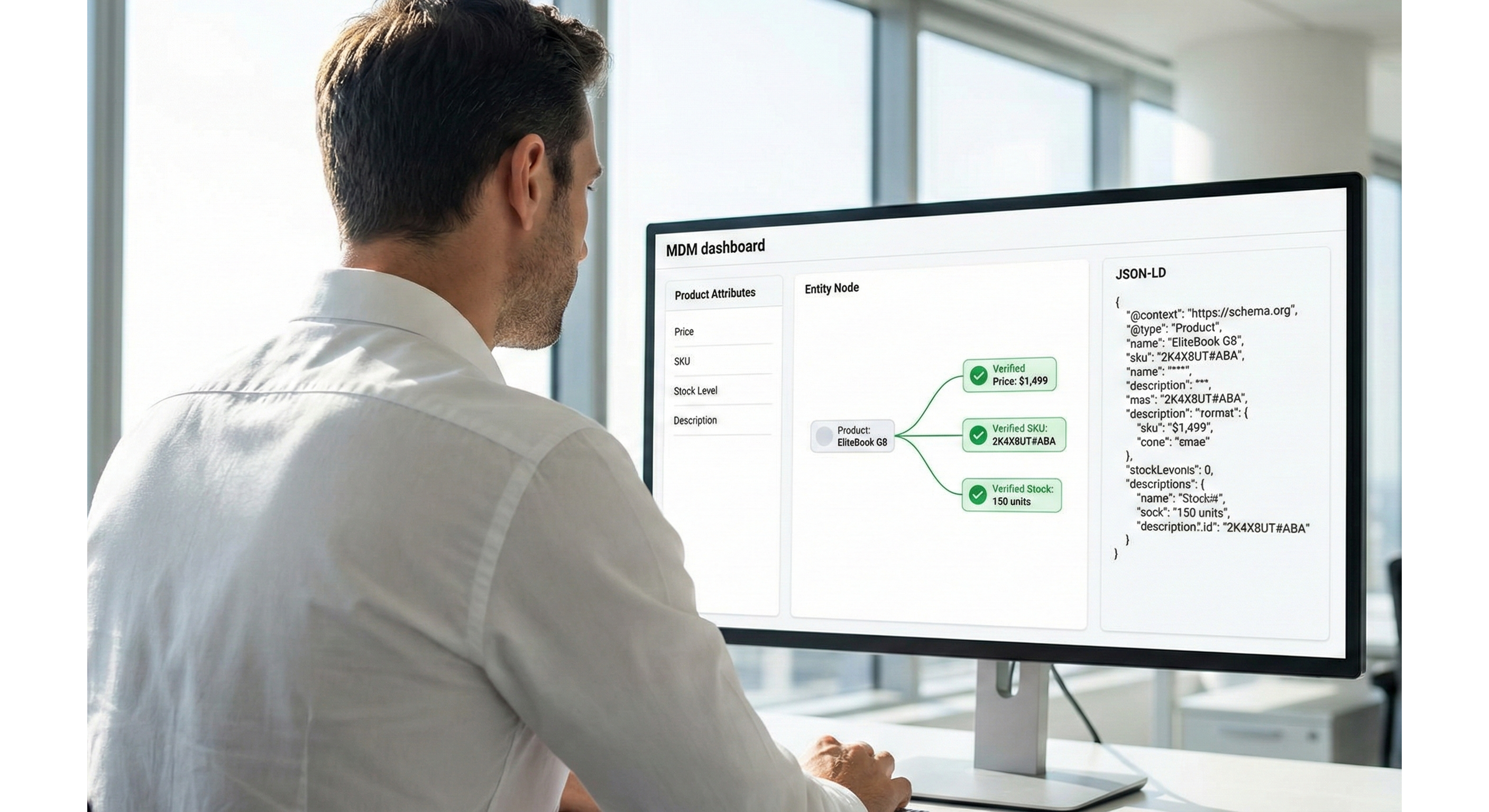
2. Content Strategy: BLUF & Query Fan-Out
AI Agents prioritize content that follows the BLUF (Bottom Line Up Front) principle. Content hubs must be linked and structured to support Query Fan-Out, answering the related sub-questions an AI generates before making a recommendation.
The Retention Mechanism: Think of the BLUF as the hook that captures the agent's attention, and the Fan-Out structure as the evidence that retains it. Without both, the agent may reference your summary but discard your site as "too shallow" for the final citation.
3. The Architecture of Authority
Trust is paramount. AI Agents are programmed to avoid hallucinations by citing high-authority sources. The goal is to build a Knowledge Graph that proves to the AI that the brand is the safest option to serve.
The Translation to Code: While the requirement for structured truth is universal, the execution varies wildly by industry. A retailer proves truth through inventory data, while a service provider proves it through credential data. Below is how that distinction translates into technical strategy.
Implementation: Sector Playbooks
How to apply Transaction Layer readiness across different business models.
1. Complex Inventory & B2B
The Challenge: Procurement agents auto-compare specifications across thousands of SKUs. The shopping happens in the code, not on the category page.
- The Strategy: Migrate technical specifications from PDFs to live HTML text on product detail pages (Organic). Then, ensure this structured data powers your merchant feeds to prevent trust discrepancies between your ad and your landing page (Paid).
2. High Consideration/Longer Customer Journeys
The Challenge: Prospective users deploy AI agents to build shortlists based on rigid criteria (e.g.,"Find me an MBA under $50k").
- The Strategy: Convert tuition and curriculum data into Schema-marked tables so agents can read the program details. Use this same structured data to qualify leads in conversational ads before they even click.
3. Trust-Based & YMYL Categories
The Challenge: In high-stakes categories (Your Money or Your Life), AI Agents heavily filter for verified expertise to avoid liability.
- The Strategy: Audit all advisory content to ensure it is authored by a credentialed expert. Use
MedicalWebPageschema to signal verified advice to the organic algorithm, which in turn raises your Quality Score in agent-based vetting.
Summary
Winning the Transaction Layer is not just about who processes the payment; it is about who informs the decision. While Paid Media buys the placement, Organic builds the Architecture of Authority that ensures the AI Agent trusts the brand enough to recommend it.
To understand the full framework of optimization for the AI era, look out for our upcoming guide on The Architecture of Authority.
Appendix: Sources
Paid Media Sources
- Technical Documentation: Universal Commerce Protocol (UCP) Developer Guide (Google for Developers)
- Market Data: AI’s Big Impact on Holiday Shopping (Yahoo Finance)
- Transaction Data: AI-Native Commerce: Transaction Statistics & Trends (Nevermined)
- Consumer Behavior: Shoppers Turned to AI This Holiday Season (eMarketer)
Organic Sources
- The Shift to Answer Engines: Gartner Forecasts Search Engine Volume to Drop 25% (Gartner)
- The Science of GEO: Generative Engine Optimization (GEO) (Cornell University / arXiv)
- Zero-Click Behavior: The Rise of Zero-Click Search (SparkToro)
- Technical Standards: Understand How Structured Data Works (Google Search Central)
About the Author
Written by Bea and the Arcalea Organic Team. Our mission is to guide brands through AI-driven market transformation with clarity, ethics, and measurable impact.

RESPONSES