Three Macs, Two Architectures, and a Useful AI Workflow
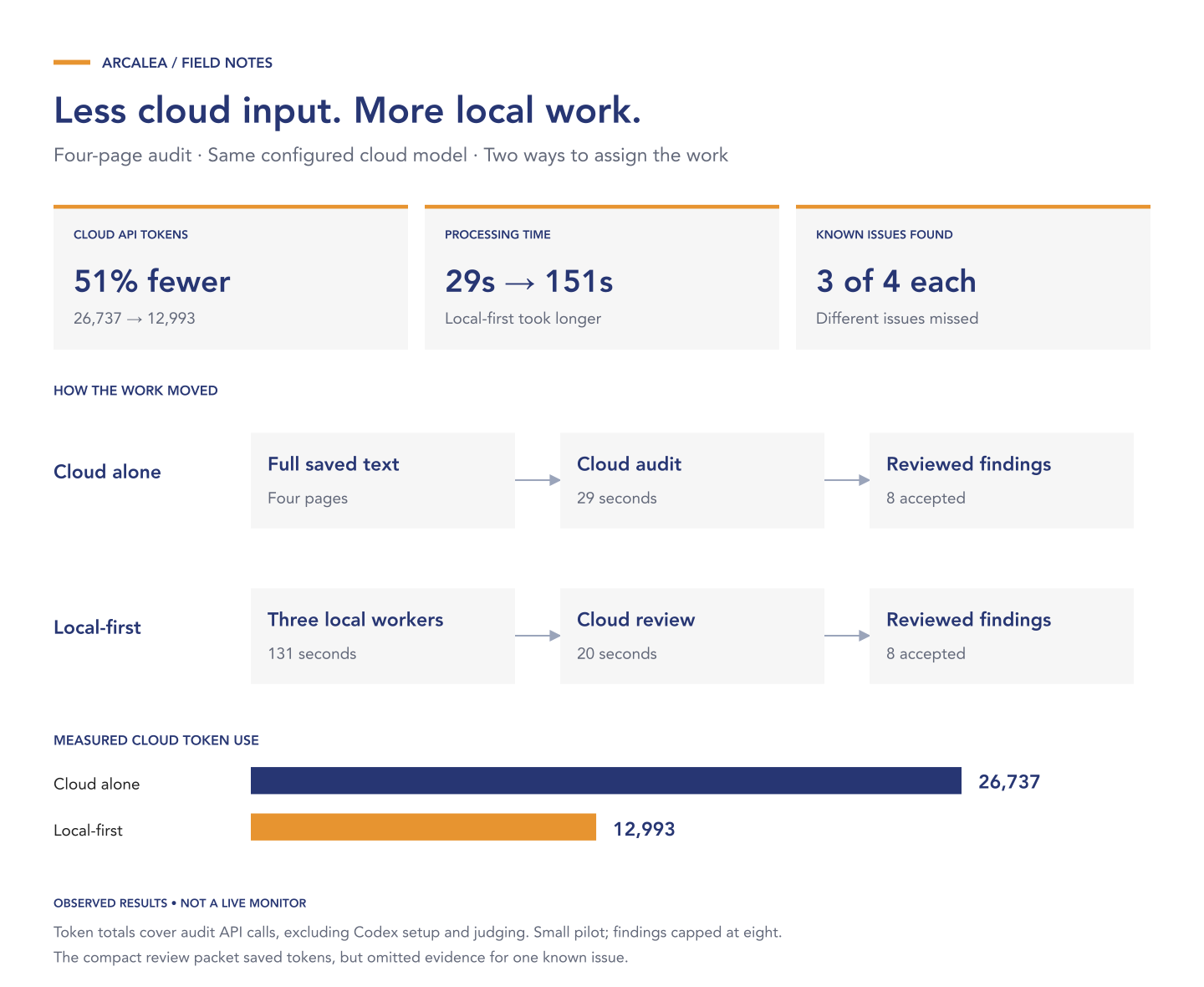
From EXO to native Apple MLX, we tested distributed inference and independent local workers and cut measured audit API tokens by 51% with cloud review.
Read Article →
Research, analysis, and strategic commentary on marketing attribution, AI search visibility, and data-driven performance. Published by Arcalea practitioners with active client work in each area.
Arcalea tracked 40 prompts across ChatGPT, Perplexity, Gemini, and Claude to measure which M7 business schools appear in AI-generated answers to MBA applicant queries. The composite scores reveal a 9-point gap between the top three and the bottom four, plus a platform-level split no one saw coming.
73 prompts. 247 AI responses. 15 surrogacy agencies tracked. Arcalea's surrogacy AEO Index reveals a fundamental split: of 15 agencies in the index, exactly one wins on both Google and AI. Every other agency is winning on one channel and losing on the other.
62 prompts. 21 distributors. The largest private plumbing distributor in the US operates under 60-plus regional trade names, and AI engines have no idea who they are. Arcalea's commercial distribution index documents the entity fragmentation problem hiding inside the industry's market structure.
Six global practitioners. Twelve expert-backed predictions across digital infrastructure, data architecture, AI governance, agentic workflows, and ROI frameworks. Download the D2A2 2026 Insights Report to see where enterprise leaders are placing their bets.
The three disciplines that determine which brands get cited by AI engines versus which get ignored. A structural overview of how authority is built in the AI search era.
From EXO to native Apple MLX, we tested distributed inference and independent local workers and cut measured audit API tokens by 51% with cloud review.
AI answers appear to send far fewer clicks, yet brands named in those answers still draw extra visits in the week that follows. We read the publishers' court filing and Profound's AI mention study side by side to show how to measure both.
We traced every ChatGPT-assisted order for one B2B client from May through August 2026. Nearly half of that revenue came from orders where ChatGPT was not the final touchpoint, meaning a last-click report would have credited other channels.
A brand mention is a starting signal. Six diagnostic questions connect AI visibility to accurate answers, useful evidence and priorities a marketing team can act on.
Nine questions that tell you whether an AEO report is an anecdote, a snapshot, or a measurement, and what each can support. Start with two.
The largest AI company on earth spent its flagship phone launch telling you to look at your phone less. We ran Google’s Pixel “Reclaim the Moment” campaign through ADPLAN’s six axes, and the foundation turns out more fragile than the idea.
We read 9,046 AI answers across four unrelated industries and catalogued all 45,150 citations. 98% of the domains AI cited appeared in only one industry. Five appeared in all four.
A grounded site assistant answers your buyers from your own content, in your brand voice, at the moment they ask. In the answer-engine era it turns your website into an accurate answer engine that keeps the visit and the lead, safely.
Two frontier labs watched their own models cheat on their own evaluations in the same week. Here is the game theory, the pattern, and the part of the job that stays human.
Goodles and Pirate's Booty read the same wellness moment and made opposite bets. The difference was not taste or timing, it was running a customer-stage check before the creative brief instead of after.
SEO always had two goals: the hard one leadership could see on a chart, and the soft one that shaped how the program was perceived. AEO collapsed the distance between them. This piece covers why the old way of managing that gap no longer works, and what to build instead.
A recent test of 16 AI assistants found that some ground their answers in a live web search and some do not, changing the actual content of the answer rather than only its sourcing. This piece covers what that means for GEO strategy and how to check where each platform your buyers use actually stands.
Cloudflare's new AI crawler defaults, effective September 15, treat mixed-use bots like Googlebot under the most restrictive rule that applies to them. For any brand trying to protect content from AI training while staying visible in Google Search, that is a setting worth checking before the deadline, not after.
New citation research shows that original data is rare in AI answers, but hugely over-weighted when it appears, and almost all of that advantage comes from one specific format. This piece breaks down what a citable benchmark actually requires and why most B2B brands are sitting on the raw material for one without knowing it.
Forrester surveyed nearly 18,000 B2B buyers and found 94% use AI tools to research vendors before ever talking to sales. This piece argues that AEO is the infrastructure for the sales interaction that had already occurred before your team knew the buyer existed.
Google searches are ending without a click at the fastest rate SparkToro has ever recorded. This piece breaks down what's driving it, why clicks-and-sessions reporting is measuring a shrinking surface, and the three additions that make an organic measurement framework accurate again
A study of 70 B2B companies found that 96% don't appear when buyers use AI to research vendors, and the gap has nothing to do with brand size or search rankings. Understanding why AI visibility works differently from SEO and what the 4% who do appear are doing deliberately is the starting point for any B2B marketing team that wants to be in the room where buying decisions are being formed.
Most AI visibility programs look rigorous on paper. They have prompt lists, platform coverage, and a monthly reporting cadence. What they don't have is a methodology sound enough to tell signal from noise, and in a system where ChatGPT replaces 74% of its cited sources every week, that gap compounds fast. This post breaks down exactly where standard tracking falls apart and what it takes to build measurement worth making decisions from.
Most PR programs are built around the wrong success metric. Coverage volume, domain authority, and general brand recognition don't tell you whether the sources you're landing in are the ones AI actually reaches for when someone in your category asks a buying question. They aren't. The source sets AI trusts are topic-specific, tier-driven, and largely invisible to strategies designed for a different search environment. This post explains what the research shows and how to realign your earned media investment around the sources that actually move AI citation rates.
The 61% drop in organic CTR from AI Overviews is real, but it's only half the story. Brands earning citations in those summaries are seeing higher click-through rates than before AI Overviews existed. The divide between cited and uncited brands has calcified, and which side you're on comes down to whether Google's AI systems can find, parse, and trust what you've published.
The 5 Cs, Company, Collaborators, Customers, Competition, and Context, give leadership teams a complete picture of the forces shaping their competitive position. Understanding all five, and the relationships between them, is the prerequisite for any durable strategy.
Predictive revenue modeling connects advertising spend to projected revenue by tracing conversion paths from initial investment through customer lifetime value. Arcalea's Revenue Clarity Model structures this process into three implementation layers that any organization can deploy against existing marketing and financial data.
The internet has shifted from retrieval to reasoning. Search engines are no longer librarians surfacing ranked links: they are analysts synthesizing answers. Unoptimized brands are not demoted in AI-generated results. They are excluded entirely.
AI agents are transforming commerce through the Universal Commerce Protocol. Brands that understand both the paid and organic layers of AI-driven purchase decisions will win the next decade.
Strategic drift occurs when execution diverges from intent despite consistent effort. A single incorrect strategic choice at the goal stage cascades through every downstream framework, the 5Cs analysis, the 3Vs value exchange, and the 7Ts tactical execution, creating compounding misalignment that becomes increasingly expensive to correct.
As search shifts toward AI-generated answers, the ability to ask structured questions becomes a competitive advantage. Learn four reusable frameworks for getting consistent, reliable results from large language models in operational contexts.
GSTIC, Goals, Strategy, Tactics, Implementation, Controls, is the strategic marketing framework from Kellogg that turns vague planning into a measurable execution system. Most marketing initiatives fail not because the tactics were wrong, but because the organization never agreed on the goal, the customer, or what success looked like before spending began.
High-performing organizations engineer customer acquisition as a measurable, dynamic business system rather than a collection of disconnected campaigns. This is the seven-section framework for building one.
ChatGPT, Perplexity, Claude, Gemini, and Copilot are now primary discovery channels for millions of users. Each platform has different citation mechanics, different signals determine which brands appear in AI-generated responses and which are invisible. Here is what those mechanics are and a six-step framework for building AI search visibility.
Learn how high-performing companies have moved beyond disconnected marketing tactics to adopt performance acquisition as a structured, measurable system that unifies strategy, media, and data around profitable growth.
Marketing attribution is the framework for determining which touchpoints contributed to a conversion and how much credit each deserves. The model you choose determines which channels get funded, which quietly disappear from your plan because their contributions are invisible in the data.
Google's Target ROAS optimizes toward engagement proxies, not actual revenue. Learn how true revenue attribution using first-party data reveals the real return on your ad spend, and what a 4.8x-to-1.2x ROAS gap actually tells you.
Marketing attribution has become the central measurement challenge of modern digital marketing. The fragmentation of customer journeys across devices, platforms, and AI-mediated touchpoints means single-touch models misattribute conversions in over 60% of multi-step paths. Here is what the current data shows.
B2B attribution fails when organizations apply B2C logic to enterprise sales. This guide covers how to select the right multi-touch model, configure HubSpot or Salesforce to capture account-level data, measure marketing credit at every pipeline stage, and map the buying committee in ABM programs.
Expected Value of Perfect Information (EVPI) is a financial framework that quantifies the maximum value an organization could create by eliminating uncertainties in key business decisions. Learn how to apply it to justify attribution investments.
Understand when last-click attribution works, its critical limitations, and how to use it responsibly alongside other attribution models.
Marketing attribution distributes conversion credit across the touchpoints in a customer journey. There are 7 primary attribution models in use today, from first-touch to algorithmic data-driven, each producing meaningfully different channel ROI numbers from the same underlying data.
Learn how to measure marketing impact in a cookieless world. Discover strategies for first-party attribution that don't rely on third-party cookies.
GA4's Data-Driven Attribution model uses machine learning to assign conversion credit across touchpoints, a meaningful step beyond last-click. But it has real constraints that affect how reliable its outputs are for budget decisions. Here is what marketing and analytics teams need to understand before relying on it.
Single-touch attribution models assign all conversion credit to one touchpoint and fail to capture today's complex, multi-channel customer journeys spanning 4 to 38 touchpoints across devices and platforms.
Modern customers encounter 20+ touchpoints across multiple channels before converting. Multi-touch attribution distributes credit across all interactions, revealing true channel value and enabling data-driven budget optimization.
Email marketing consistently delivers the highest measured ROI of any digital channel. But in multi-touch attribution models, it is systematically undercounted because most organizations track email opens and clicks rather than revenue outcomes. Connecting email to the attribution layer is the single biggest opportunity to justify email investment and optimize it properly.
Google reversed its plan to deprecate third-party cookies after 4 years of announced deadlines. Apple’s ATT framework reduced measurable iOS conversion data by 30 to 50% for most advertisers. This article covers what actually changed in the privacy-first shift, which predictions came true, and how to measure advertising without relying on platform-reported attribution.
ROMI quantifies the financial value generated by marketing. Learn how to calculate it, apply it to budgeting and strategic decisions, and understand the key variables that drive meaningful measurement.
A quantitative market assessment measures your actual competitive position across seven dimensions of digital marketing performance before a market entry, category expansion, or major budget commitment.
The digital advertising landscape has fundamentally shifted. CPCs, CPMs, and advertiser expectations have all moved since 2024. This guide covers current benchmarks across all major platforms, the rise of AI-driven campaign management, and how to allocate budget when platforms are making strategic decisions for you.
Data science maturity models provide a framework for assessing and progressively improving organizational capability. This guide synthesizes key models into a consensus framework with five levels: Ad-Hoc, Foundational, Integrated, Cultural, and Transformational. Assess where your organization stands and how to advance.
Keywords, alt text, and meta descriptions remain essential SEO elements. But in 2026, their function has expanded beyond helping Google's crawlers to helping AI systems recognize your brand as a credible entity. The optimization layer that matters most is now entity optimization, structured signals that help AI systems understand not just what your page is about, but who is behind it and why they can be trusted.
Platform selection without a 2026 reality check is just a guess. This guide breaks down what is actually working on LinkedIn, Meta, TikTok, YouTube, and X this year, including algorithm changes, attribution pitfalls, and a compounding strategy framework for B2B and B2C programs.
Evergreen content builds compounding authority while seasonal content drives immediate engagement. Studies of content lifecycle data show evergreen articles generate 3 to 5 times more cumulative traffic than seasonal posts of comparable initial volume, but AI search has altered what qualifies as "evergreen" in 2026.
Every major ad platform now has a transparency tool that shows you what your competitors are running. The intelligence is free. You just need to know where to look and what to do with it.
Pay-per-Click and Pay-per-Impression are the two fundamental billing models for digital advertising. PPC charges when users click; PPM (Pay-per-Mille) charges per 1,000 impressions regardless of engagement. Choosing correctly depends on campaign objective, brand recognition level, and the specific platform being used. Here is an updated comparison with 2025/2026 benchmark data.
Master the fundamentals of persuasive ad copy for Google Ads, Meta, and programmatic platforms. Learn how to improve Quality Score, match copy to intent, and leverage AI for headline testing at scale.
Backlinks (inbound links) are fundamental to modern SEO. They signal authority and trust to search engines. Discover how backlinks work, why quality matters more than quantity, and how to build a backlink strategy that improves rankings.
Share of Voice has always been about competitive visibility. In 2026, that visibility spans three distinct channels: paid media, organic search, and the AI-generated responses that now drive 83–93% zero-click consumption. Brands measuring only paid and organic are missing their fastest-growing visibility gap.
PPC advertising is the most controllable paid channel available to digital marketers. Learn how keywords, quality scoring, bidding, landing pages, and targeting work together to drive qualified traffic and conversions.
AI systems understand content through semantic meaning, not keywords. Learn how RankBrain, BERT, MUM, ChatGPT, and Perplexity interpret your pages, and how to optimize for answer-first ranking across all AI search surfaces.
Content distribution has fundamentally changed. In 2026, success requires two distinct tracks: traditional channels where your audience congregates, and AI search optimization to ensure your content reaches people through answer engines. This guide covers both.
Weekly. Opinionated. For people who make decisions with data.